
Selected patients with Afro-textured hair may be suitable when donor capacity, a stable transplantable pattern, medical clearance and realistic expectations are present. Hair texture alone does not decide candidacy.
Candidacy GuidanceAfro-Textured Hair Restoration in Istanbul
Afro Hair Transplant in Turkey
An Afro hair transplant in Turkey is planned around curved or changing follicle paths beneath the scalp, not the visible curl alone. At Henesis Clinic, donor capacity, follicle characteristics and individual suitability are assessed before FUE, DHI or a combined workflow is recommended.
- Afro-focused assessment
- Doctor-led planning
- Documented cases
- Evidence-led planning
Afro hair transplant essentials
Afro Hair Transplant in Turkey — Quick Answers
The main difference is that the follicle path beneath the scalp may curve or change, so extraction cannot assume a straight trajectory. Donor assessment and adapted distribution follow the observed anatomy.
Understand the DifferenceFUE, DHI or a combined workflow may be used. Technique follows donor anatomy, existing hair and recipient priorities—not a single preferred method for all Afro-textured hair.
Compare TechniquesSelected publicly advertised 2026 Turkey prices are approximately $2,000–$5,000. Henesis plans range from $3,190 to $5,450 after individual assessment.
Review Cost ContextThe essential difference
Why Is Afro Hair Transplant Different?
Afro-textured hair can have curved or changing follicle trajectories below the scalp. Because the visible exit angle does not always reveal the full follicle path, donor extraction may require case-specific assessment and adaptation, including when planning an Afro Beard Transplant.
- Visible Curl
- Possible Sub-Surface Curvature
- Adapted Extraction
- Donor Preservation
Clinical decision panel
What We Assess Before Recommending a Technique
Curl & Follicle Characteristics
Observed curl pattern and extraction considerations.
Donor Capacity & Distribution
The available donor resource and how extraction may be distributed responsibly.
Hair Calibre
Hair-shaft characteristics that influence visual coverage.
Hair-Loss Pattern & Existing Hair
Current recipient needs, pattern stability and preservation around existing follicles.
Scalp / Scar History
Previous procedures, healing history and relevant scalp factors.
Long-Term Donor Demand
Potential future areas of loss and the donor resource that may need to remain available.
Technique comes after assessment.
Explore Our Medical Standards
Candidate decision
Can You Get a Hair Transplant With Afro-Textured Hair?
Many people with Afro-textured hair can be considered for transplantation, but hair texture alone cannot determine suitability.
- Stable or localized hair loss
- Sufficient donor resource
- Realistic density expectations
- Medical suitability
- Reconstructable treatment priorities
- Diffuse or unstable hair loss
- Limited donor availability
- Previous donor depletion
- Significant scalp or scarring history
- Expectations beyond donor capacity
Suitability cannot be determined from hair texture alone.
Different patterns, individual plans
Afro Hair Transplants for Black Men and Women
Black men, Black women and African American patients are assessed by hair-loss pattern, donor resource, scalp history and existing hair—not by a demographic label or a single assumed follicle type.
Pattern and Priority Assessment
Planning may focus on frontal recession, temples, hairline, crown, or correction after a previous procedure. Donor demand and future non-transplanted hair loss remain part of the decision.
- Frontal recession
- Temples and hairline
- Crown restoration
- Previous transplant repair
Suitability and Existing-Hair Preservation
Female assessment should distinguish localized transplantable areas from diffuse or active patterns that may require further evaluation before surgery is considered.
- Hairline or temporal changes
- Traction-related patterns
- Diffuse-thinning considerations
- Styling and hair history
Extraction centerpiece
The Main Technical Challenge: Following a Curved Follicle
The surface exit angle does not necessarily show the complete sub-surface trajectory. Where curvature is present, extraction strategy may need to adapt so unnecessary follicle transection is minimized while donor distribution remains controlled.
No fixed trajectory or punch strategy applies to every patient. Observation, donor assessment, operator experience, and case-specific planning matter.
Technique follows anatomy
FUE, DHI or a Combined Approach for Afro Hair?
FUE describes a donor-extraction method. DHI primarily describes a recipient-placement workflow and still requires an appropriate donor-extraction strategy.
| Consideration | FUE / Sapphire FUE approach | DHI placement |
|---|---|---|
| Donor extraction | Individual follicular extraction planned around donor characteristics. | Still requires donor extraction before implantation. |
| Recipient creation | Channels are planned before graft placement. | Placement can be performed with an implanter workflow. |
| Existing hair | Suitability depends on recipient access and the individual plan. | May be useful in selected situations involving existing hair. |
| Shaving | Depends on donor and recipient planning. | Selected cases may allow reduced shaving; this is not automatic. |
| Afro-specific decision | Follicle trajectory and extraction planning remain central. | Recipient control does not remove the extraction challenge. |
Clinical oversight
Clinical Oversight for Afro Hair Restoration
Dr. Timur Aksu, MD
Lead Hair Restoration PhysicianAfro-textured follicle assessment · FUE extraction · donor management · complex restoration planning
Medical planning for Afro-textured hair should follow the observed donor and follicle characteristics rather than a standard technique or graft package.
View Dr. Aksu’s ProfileDocumented patient cases
Afro Hair Transplant Before & After
Case results should be interpreted with their follow-up point, hair characteristics, donor capacity, technique, and treatment area—not as a universal outcome.
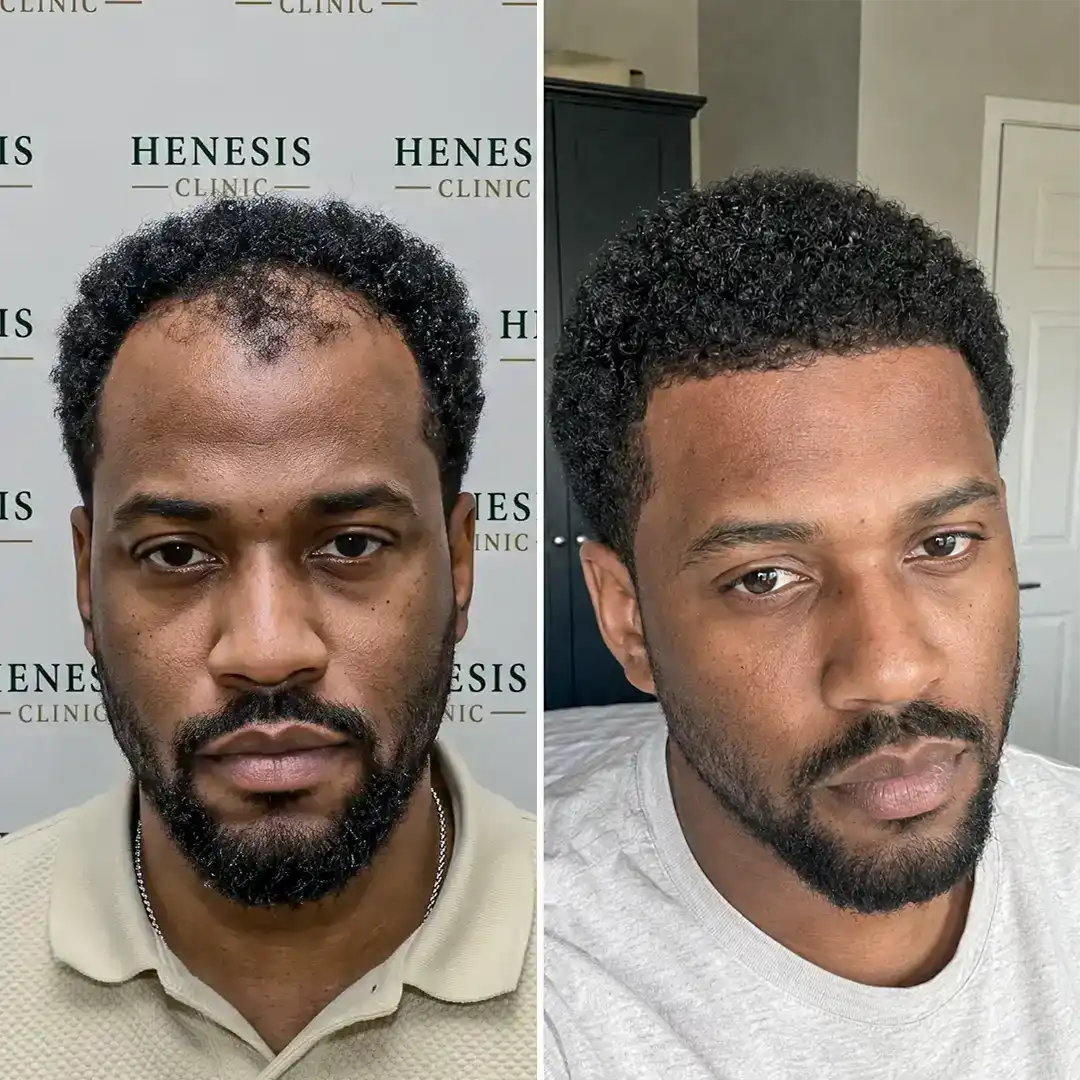 Before
After
Before
After
DHI Hair Transplant
Afro Hair Transplant — 3,250 Grafts
- Technique
- DHI
- Graft Count
- 3,250 grafts
- Treatment Area
- Hairline, Frontal Region And Mid-Scalp
- Follow-Up
- 12-Month Follow-Up
Doctor: Dr. Timur Aksu, MD
View Clinical Case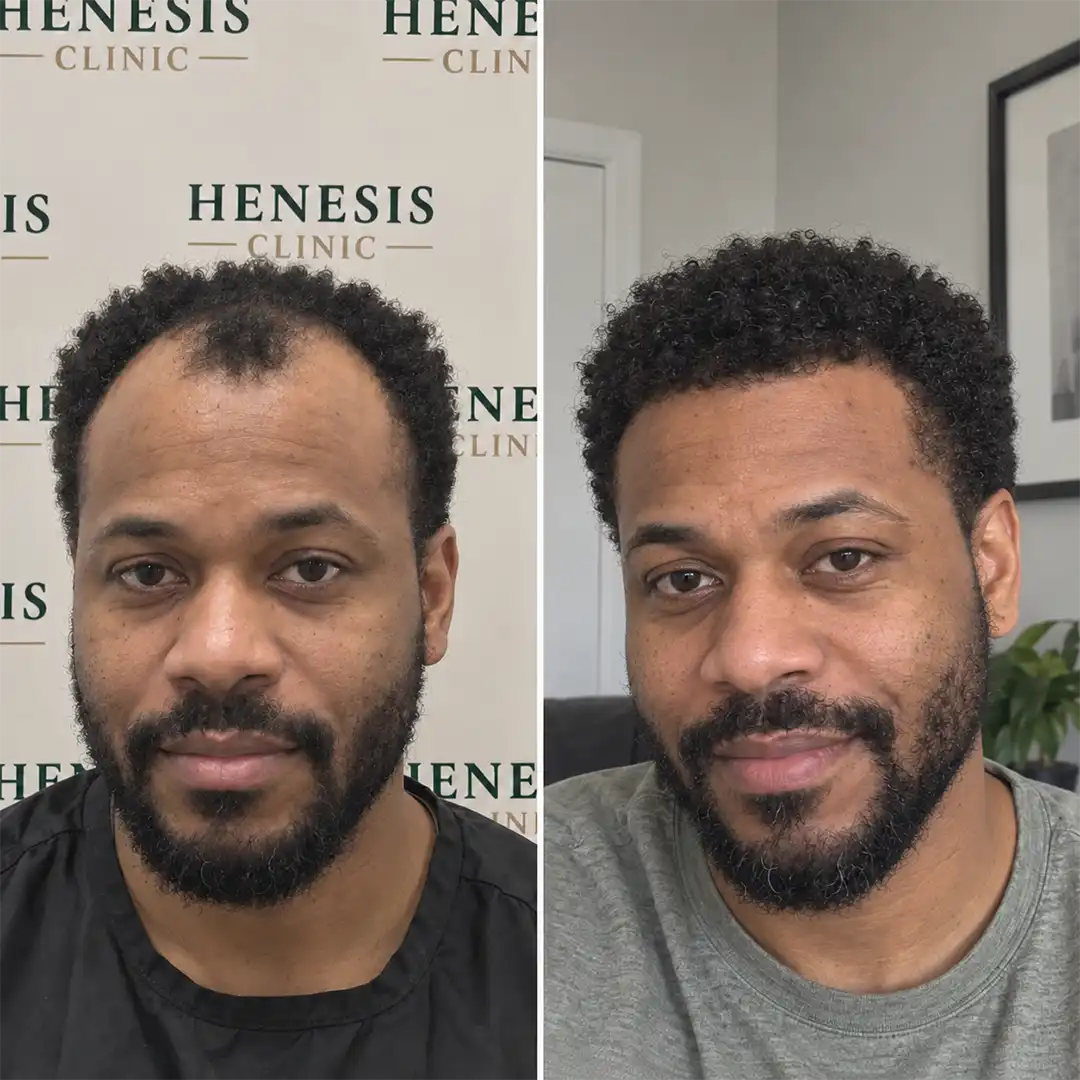 Before
After
Before
After
Combined Sapphire FUE + DHI Hair Transplant
Afro Hair Transplant — 3,300 Grafts
- Technique
- Combined Sapphire FUE + DHI
- Graft Count
- 3,300 grafts
- Treatment Area
- Hairline, Frontal Region And Mid-Scalp
- Follow-Up
- 12-Month Follow-Up
Doctor: Dr. Nora Derin, MD
View Clinical Case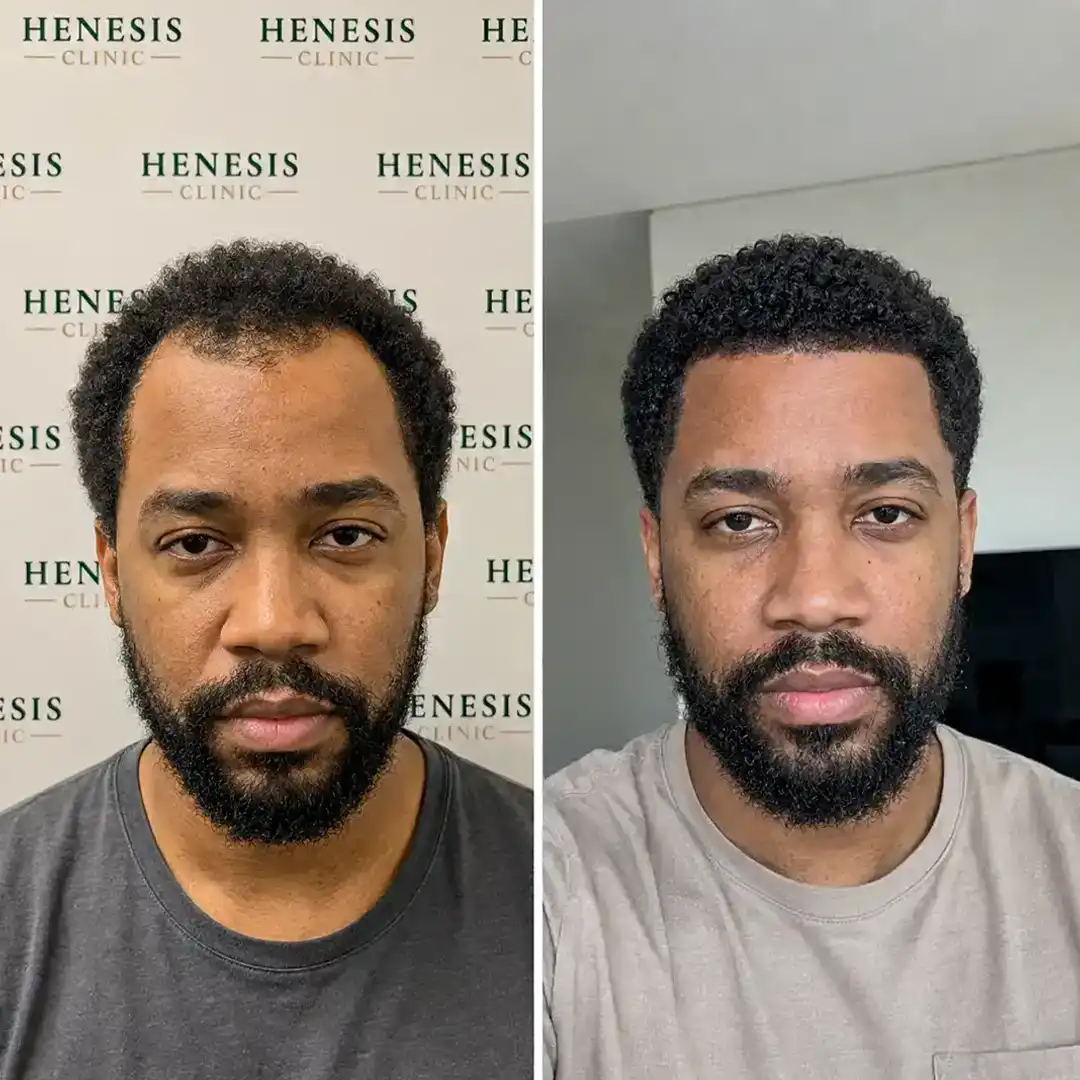 Before
After
Before
After
FUE Hair Transplant
Afro Hair Transplant — 3,200 Grafts
- Technique
- FUE
- Graft Count
- 3,200 grafts
- Treatment Area
- Hairline, Frontal Region And Mid-Scalp
- Follow-Up
- 12-Month Follow-Up
Doctor: Dr. Nora Derin, MD
View Clinical CaseQuick cost answer
Afro Hair Transplant Cost in Turkey
Selected publicly advertised 2026 Turkey prices reviewed for the Henesis Cost Guide indicate a broad market context of approximately $2,000–$5,000. Henesis hair transplant plans currently range from $3,190 to $5,450, with the final treatment plan confirmed after individual assessment.
Henesis Afro Hair Transplant · USD
$3,190–$5,450
Final treatment plan and quotation follow individual assessment.
Case-Specific Pricing
Afro-textured follicle characteristics can affect treatment planning, but Henesis does not apply a universal “Afro surcharge.” The applicable plan follows the individual clinical assessment.
View 2026 Prices, Plans & Market MethodologyIllustrative Henesis Planning Ranges
How Many Grafts Might Be Needed?
Small Hairline / Temple Area
Illustrative planning range: approximately 800–1,500 grafts
Frontal Zone
Illustrative planning range: approximately 1,500–2,500 grafts
Front + Mid-Scalp
Illustrative planning range: approximately 2,500–3,500 grafts
Large Multi-Zone Area
Illustrative planning range: approximately 3,500+ grafts
These ranges are illustrative Henesis planning examples used for general education and are not universal clinical standards or personal recommendations. Afro-textured hair can create visual coverage differently depending on curl, calibre, donor characteristics and recipient area.
Henesis does not calculate the treatment quotation by multiplying a graft estimate by a fixed unit price.
See How Graft Count Affects Treatment CostAfro-specific workflow
How Afro Hair Changes the Transplant Procedure
- 01
Medical & Donor Assessment
Afro-specific consideration: Medical suitability, follicle characteristics, donor capacity, hair-loss stability and goals are assessed together.
- 02
Donor Mapping
Afro-specific consideration: Density, distribution, curl characteristics and previous extraction are reviewed across the donor area.
- 03
Hairline & Recipient Planning
Afro-specific consideration: Direction, irregularity, visual coverage, existing hair and long-term demand guide the design.
- 04
Curved-Follicle Extraction
Afro-specific consideration: Curved sub-surface paths may require adaptation instead of an assumed straight trajectory.
- 05
Graft Handling & Recipient Placement
Afro-specific consideration: Graft organization, angle, direction, distribution, curl behavior and existing hair influence placement.
- 06
Post-Procedure Review & Follow-Up
Afro-specific consideration: Donor distribution, recipient direction, washing, healing and growth progress are reviewed according to the individual procedure.
Recovery guidance
Does Recovery Differ for Afro-Textured Hair?
The overall recovery pathway is not defined by Afro hair texture alone. Aftercare follows the procedure performed, donor and recipient healing, scalp condition and individual clinical needs. The most noticeable early healing changes usually occur during the first 7–10 days, while hair growth develops gradually over subsequent months.
Informed decisions
Afro-Relevant Risks and Limitations
Afro-specific planning does not eliminate the general risks of hair transplantation. The points below are particularly relevant to donor preservation, curved-follicle extraction and long-term restoration planning.
Follicle Transection
Curved sub-surface paths may make extraction more demanding.
Donor Overharvesting
Concentrated or excessive extraction can reduce future donor options.
Scarring / Healing History
Previous scarring and individual healing responses should be discussed before treatment.
Density & Direction Limitations
Visual coverage and direction depend on donor supply, graft distribution, curl behavior and recipient planning.
Future Non-Transplanted Hair Loss
Non-transplanted hair may continue to change and affect the long-term appearance.
Scalp Conditions & Candidacy
Active inflammation, scarring hair loss or untreated scalp conditions may affect suitability, healing and long-term planning.
A history of problematic scarring or keloid formation should be discussed during medical assessment rather than assumed from skin tone or ethnicity alone.
Choosing responsibly
How to Choose an Afro Hair Transplant Clinic in Turkey
Searching for the best Afro hair transplant clinic in Turkey is more useful when “best” means documented Afro cases, donor evaluation, physician responsibility and curved-follicle planning—not a ranking or package price. A lower price or higher graft number does not answer who is responsible for care or how donor capacity is protected.
Can the clinic show documented Afro cases?Who assesses follicle and donor characteristics?Who performs the extraction?How is donor preservation planned?How are curved follicles approached?What happens if you are not suitable? Compare Hair Transplant Prices and Package Scope
Turkey and Istanbul
Why Patients Travel to Istanbul for Afro Hair Transplantation
Istanbul can make international treatment planning more practical, but the destination should remain secondary to physician responsibility, donor planning and documented clinical standards.
- International-patient coordination
- Direct flight options from many regions
- Treatment and travel planning in one city
- Different cost context from some home markets
Medical content reviewed by Dr. Timur Aksu, MDLead Hair Restoration Physician · Last reviewed 22 August 2026
Afro Hair Transplant FAQs
Clear answers about suitability, technique, cost, recovery, scarring, and clinic selection.
Can Afro hair be transplanted?
Yes. Many people with Afro-textured hair can be considered for a transplant. Suitability still depends on medical history, hair-loss pattern, donor capacity, follicle characteristics and realistic goals—not texture alone.
Is Afro hair transplant more difficult than straight-hair transplantation?
It can be more demanding because the follicle path beneath the scalp may curve or change. The degree of curvature varies, so extraction is adapted to the observed path rather than assumed from visible curl.
Is FUE or DHI better for Afro hair?
Neither FUE nor DHI is universally better for Afro hair. FUE describes extraction; DHI mainly describes placement. The combination follows follicle anatomy, donor characteristics, existing hair and recipient priorities.
How much does an Afro hair transplant cost in Turkey?
Selected publicly advertised 2026 Turkey prices are approximately $2,000–$5,000. Henesis plans range from $3,190 to $5,450 after individual assessment. The applicable plan still follows the confirmed clinical scope.
How many grafts do I need for Afro hair?
There is no universal graft number for Afro hair. Illustrative frontal plans may use roughly 1,500–2,500 grafts, while broader areas may need more; the personal estimate depends on donor capacity, curl, calibre and long-term planning.
Can Black women have a hair transplant?
Yes, selected Black women may be suitable when loss is localized and the donor resource is sufficient. Diffuse thinning, active traction-related loss or unstable patterns need further assessment first.
Can a hair transplant treat traction-related hair loss?
It may be considered in selected stable cases, but ongoing traction, scalp condition, scarring, available donor hair, and the pattern of loss need to be assessed before transplantation is recommended.
Does Afro hair require a larger punch?
There is no universal punch size for all Afro-textured hair. Tool and extraction decisions should follow the observed follicle and donor characteristics rather than an assumption based only on ethnicity or visible curl.
Can Afro hair transplant leave scars?
Any surgical extraction can leave small scars, and healing differs between people. Previous scar or keloid history should be discussed during assessment rather than inferred from skin tone alone.
How long does an Afro hair transplant take to grow?
Visible growth often starts over several months, and maturation can continue longer. Temporary shedding may occur first; timing and density vary between patients.
Is Afro hair transplant permanent?
Transplanted follicles from a suitable donor area are generally expected to last long term, but this is not an outcome guarantee. Non-transplanted hair can still thin, so donor preservation and future loss remain part of planning.
How do I choose an Afro hair transplant clinic in Turkey?
Compare documented Afro cases, named physician responsibility, donor evaluation, curved-follicle planning and what happens if you are not suitable. Price or graft number alone does not identify the right clinic.
Medical References
Sources Supporting Key Clinical Information
Selected sources are provided for anatomy, Afro-textured extraction considerations, traction-related hair loss, procedural risks, and recovery context.
- Advances and challenges in hair restoration of curly Afrocentric hairPubMed
- Comparative study of a follicular-unit extraction tool for Afro-textured hairPubMed
- Human hair keratin network and curvaturePubMed
- Hair TransplantationNCBI Bookshelf / StatPearls
- Traction alopeciaDermNet
- Hair replacement surgery and hair transplantsDermNet
